Claude Mythos preparation is needed in weeks, not months: a practical playbook for northern fintechs and scaleups
We’re delighted to share some expert insight on Anthropic’s new Claude Mythos model and what it means for Northern FinTechs and scale-ups, from our partners Softwire.
The UK’s northern fintech and scaleup ecosystem has spent the last few years getting taken seriously. The next twelve months will decide which of those companies are still standing once AI-native attackers turn up at the door.
Anthropic’s Claude Mythos is the headline name, but it isn’t really about Mythos alone. The Cloud Security Alliance’s latest briefing, “The AI Vulnerability Storm: Building a Mythos-ready Security Program,” is blunt: comparable offensive capabilities will arrive in other frontier models within months and in open-weight models within six to twelve.
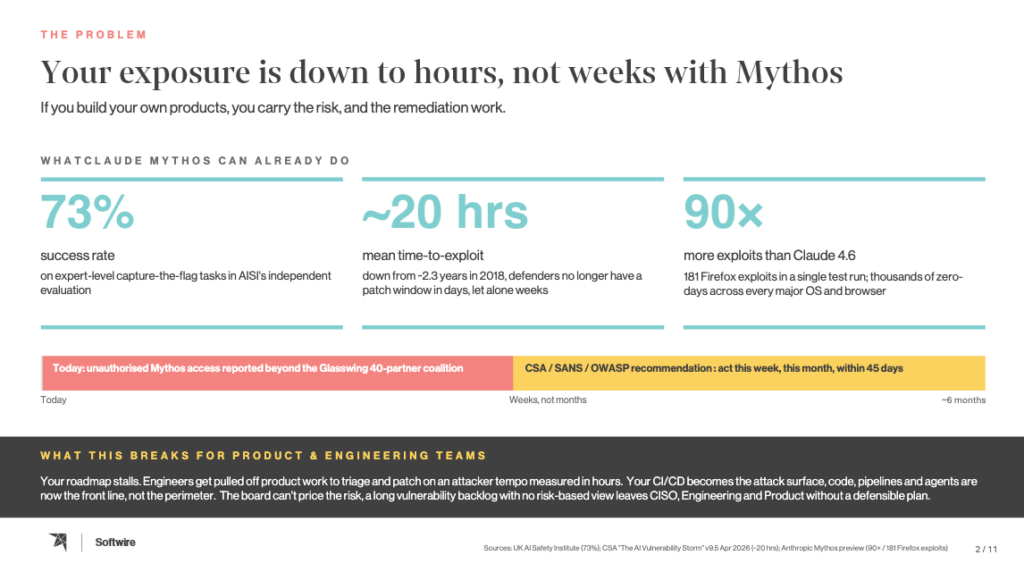
The window the industry was hoping for doesn’t exist. And there are now reports of Mythos access leaking beyond the 40-partner Project Glasswing coalition Anthropic set up to give critical-infrastructure partner’s early defensive access. The fence is already down.
Glasswing is for the FTSE 100. The middle of the market is on its own.
Glasswing is a sensible programme: get Mythos-class capabilities into the hands of the biggest banks, OS vendors, browser teams and critical-infrastructure providers so they can patch ahead of disclosure. It is also, by design, exclusive. The CSA briefing puts it plainly: “the world’s exploitable attack surface is vastly larger than what any curated partner ecosystem can cover, and most organisations that build or maintain critical software will not have early access to Mythos-class capabilities.”
If you are a Series B fintech in Leeds or a scaling lender in Manchester, that is you. Big enough to be targeted, too small to be inside Glasswing.
Weeks, not months: the CSA tempo
The CSA briefing’s timelines are aggressive on purpose. Critical actions are framed in days and weeks, not quarters. The Zero Day Clock now measures time-to-exploit in hours with forecasts of exploits within 1 day and 1 hour in 2026 . Sysdig has already documented an AI-driven attack reaching admin-level access in eight minutes.
Anthropic has reported more than 500 high-severity vulnerabilities in open-source software found by Claude Opus 4.6, and AISLE surfaced twelve OpenSSL zero-days including a CVSS 9.8 flaw dating back to 1998. Mythos-class capability does not sit ‘a few months down the line’. It is already producing real-world findings every week, and that pace is the new floor.
The harder problem is on the defender side. Cyber governance advice can arrive quickly: a competent assessor will tell you where you are exposed and what to do about it. Making the fundamental engineering and process changes that recommendation implies is a different timescale entirely.
When you are still building your product, even an organisation with one or two technical teams can take weeks or months to roll a control change widely across CI/CD, code, infrastructure and agents. Annual risk register reviews, quarterly board updates and six-month remediation plans were not built for an exploit cadence measured in days and hours.
The opportunity hiding inside the threat
There is a counter-intuitive prize here for scaleups that move fast. A post-Mythos market is one where consumer trust gets re-priced. When AI-driven breaches start hitting consumer-facing brands, money quietly flows toward whoever is visibly secure. Bigger institutions look stable by default; smaller players who can credibly demonstrate Mythos-readiness can punch well above their weight. The fintechs that come out of the next twelve months with reputation intact will take share.
The catch is that “credibly demonstrate” is engineering work, not a policy statement.
Why pure cybersecurity advice will leave you stranded
The three actions the CSA report flags as critical are, in plain terms, engineering decisions made inside your codebase and CI/CD pipeline:
– Point AI agents at your code. LLM-driven security review of every change, human or AI-generated, before merge, with agentic scanning embedded in CI. That means hands inside your repos, your branch protections and your PR gates.
– Adopt AI agents in your secure coding practices. Bring agents into how your engineers ship and how your security function actually works. Tools, harnesses, prompts, evaluations and guardrails: production engineering, not a deck.
– Defend your agents. Audit prompts, tool definitions, retrieval pipelines and escalation logic. Set scope, blast radius and override paths before agents go to production. These are software design decisions made in code: context windows, tool schemas, sandboxing.
A traditional cyber consultancy will identify these gaps accurately and hand you a remediation plan. They will then need your engineers to do the work, which means pulling those engineers off the roadmap you are paid to deliver. You end up with a recommendation and a resourcing problem.
Who are Softwire
Softwire is, first and foremost, an engineering business that was founded with the core idea of “Saving the world from bad Software”. Softwire has Twenty-five years of building production systems for small and large organizations and has a deep financial services & central government experience where building safe & secure engineering practices is paramount.
What Softwire does differently
When you are building your own product, you need to defend against Mythos-class threats at source. That means changes in the pipeline, in the code and in the agent stack. It is not the same problem as protecting the off-the-shelf systems around it.
Our Mythos-readiness offering opens with a two-week sprint of workshops across your engineering, security and risk leads, covering CI/CD, code, agents and infrastructure. By the end of week two you have a costed, prioritised action plan mapped to the CSA criticality list showing realistic resolution targets in weeks as well as: 45-day, 90-day and 6-months.
From there we can keep going at whatever shape best fits your organization. We can add capacity to your existing team, provide ongoing advice and review, or spin up whole engineering squads to deliver the changes for you. We can do this alongside and in collaboration with existing cybersecurity, governance of infosec specialists in your organisation.
Typical engineering follow-on includes LLM-driven security review wired into your CI, agent harness hardening, authentication and authorisation uplift, plus detection uplift across the pipeline. Posture in weeks, not months, built into the pipeline, not bolted on as an afterthought.
Get in touch
If you are building a fintech or scaleup product and you want to be on the right side of the Mythos curve, talk to us. Email FinancialServices@Softwire.com and we will set up an initial conversation.
The full CSA briefing is worth reading in its entirety: The AI Vulnerability Storm: Building a Mythos-ready Security Program.