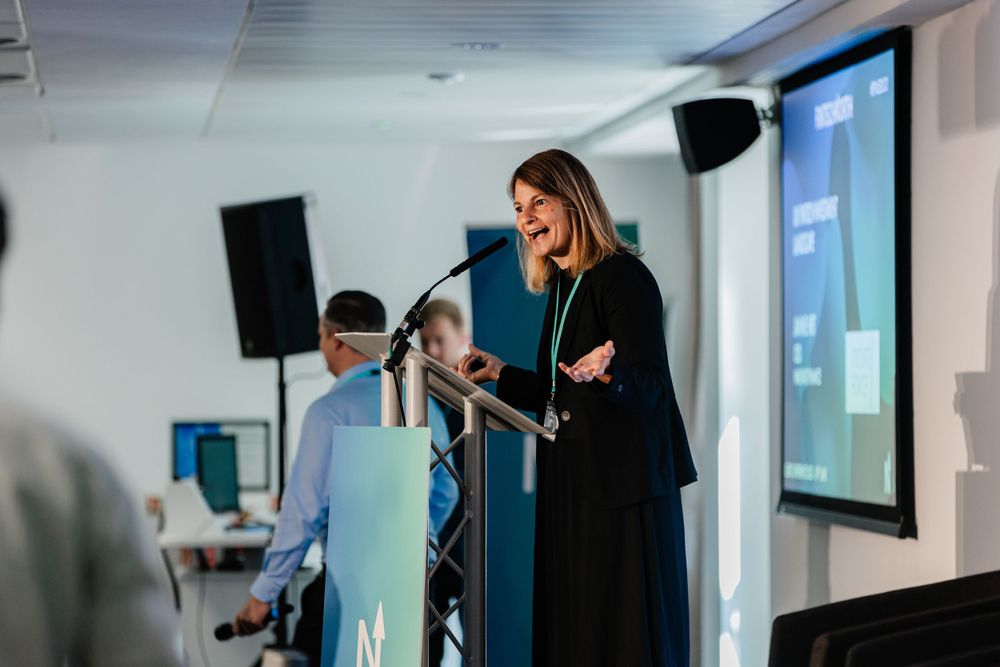
Leeds Conference 2026 Write-up
On Wednesday 24th June, the Northern FinTech community came together to celebrate a truly special occasion: FinTech North’s 10th anniversary, held back where it all began, at aql in Leeds – brand sponsored by West Yorkshire Combined Authority, Bruntwood SciTech, PEXA, Softwire, Lenvi, Mastercard, Sedulo, Leeds Credit Union and aql, name badge and evening social sponsors GoCardless, networking and lanyard sponsors The Data City, and legacy sponsors incuto.
The day was marked by record-breaking heat – but the community turned out in force regardless, with around 220 attendees across the day and 80% turnout. It was also an occasion for a tribute to FinTech North’s late chairman, Chris Sier, recognising his pivotal role in shaping FinTech North and the way he challenged the sector – because that’s what drives real change.

Photos from the day, courtesy of our photographer Lou Wilcock, are linked here.
Welcome from FinTech North
The day opened with a welcome from Ryan Walsh, Marketing & Community Manager, FinTech North, and Stefan Haase, Director, Whitecap Consulting, setting the tone for a celebration of ten years of Northern FinTech growth.
Welcome from aql
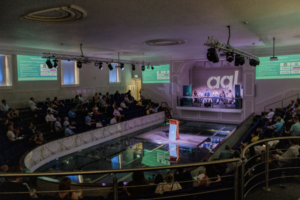
Professor Adam Beaumont, CEO & Founder, aql, delivered a powerful welcome and tribute to Chris Sier – walking barefoot across the glass floor above aql‘s data centre, just as Chris had done ten years earlier. Adam shared that aql has sent 27 million messages on behalf of parkrun and now manages two-factor authentication messaging for many of the world’s banks from its UK footprint here in Leeds, and has become the beating heart of Leeds’ digital economy. Reflecting on the wider ecosystem, he noted that ten years ago ‘everything was happening in London,’ whereas today that activity is very much taking place here in Leeds too.
The Chris Sier Keynote
Peter Cunnane, Director of International & Partnerships, Innovate Finance, delivered the Chris Sier keynote – a personal and moving address reflecting on his friendship with Chris since first meeting him in Leeds in 2013, and on Chris’s role in founding the FinTech National Network and shaping the Kalifa Review. Peter reminded the room that while Chris may have trodden lightly on that floor, he never trod lightly when it came to advocating for FinTech in the North.
Peter spoke candidly about the UK’s economically and geopolitically challenging climate, the need to protect the UK’s competitive regulatory advantage on stablecoins and AI, and Innovate Finance’s continued work supporting scaling businesses across the UK, not just London. He closed with a direct challenge to the room, in the spirit of Chris Sier:
‘With or without your shoes on… no more excuses: why can’t we be first?’
FinTech in Leeds, 10 Years On
Chaired by Stefan Haase, Director, Whitecap Consulting, this panel brought together Jennifer Anderson, CIO, National Wealth Fund; Sushil Kuner, Partner & Head of Financial Services Regulation, Freeths; Sebastian Ricketts, Senior Manager, Innovation, FCA; and Richard Carter, CEO, Lenvi, to reflect on a decade of change. Richard recalled that ten years ago, the idea of a FinTech ecosystem in the North barely existed, and that finding VC investors in the region was a real struggle – he wants the next ten years to see founders moving from London to Leeds to build, rather than the other way around, on the strength of the city’s infrastructure and talent.
Sebastian noted the FCA’s Regulatory Sandbox is also celebrating its 10th anniversary, highlighted the FCA’s growing presence in Leeds alongside other major national institutions, and pointed to payments, lending and BNPL as use cases that originated in the North. Jen spoke about the significance of the government choosing Leeds for the National Wealth Fund as a real recognition of the city’s financial services strength, while Sushil brought a legal and ex-FCA perspective on how far the regional ecosystem – including its start-ups – has come.
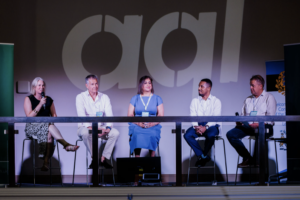
The panel also discussed the ongoing capital markets confidence gap around investing in SMEs and start-ups outside London, the importance of a highly skilled local talent pool, and the opportunity for AI and agents to put ‘a CFO in your pocket’ for consumers and small businesses in the years ahead.
Why West Yorkshire?
Tracy Brabin, Mayor of West Yorkshire, gave an energetic address on why West Yorkshire is the place to build: ‘We turn ideas into impact… (because of) the people, the disruptors, the innovators.’ She referenced her February trade mission to Switzerland alongside Debeo, Zygens, The Data City and rebuildingsociety.com; the new FinTech-focused degree just launched with University Centre Leeds; last year’s partnership between FinTech North and the University of Bradford; the launch of OWLworks; and the region’s Cluster Action Plans, including a proposed FinTech Accelerator developed with FinTech North and the University of Leeds.
Tracy also pointed to the region’s 17,000 STEM graduates, the recent first-ever FCA regional sprint, and the newly launched Tech West Yorkshire initiative, bringing together businesses, investors, universities and skills providers across Leeds, Bradford, Wakefield, Calderdale and Kirklees.
10 Years of Leeds Digital Festival
Deb Hetherington, Director, Leeds Digital, spoke about the festival’s own 10th anniversary and its position as the largest open tech model in the UK, having supported other cities and countries in setting up their own equivalents. Deb argued that thriving ecosystems need three things – physical assets, economic assets and networking assets – and that Leeds has a real density of all three, with the Northern Square Mile as the clearest example.
The Bank of England in Leeds: Regional Engagement, FinTech Collaboration and Experimental Work
Simon Morley, Director, Financial Markets Infrastructure Directorate, Bank of England, explained that the Bank’s work in Leeds mirrors what it does in London, with a presence in the city dating back to 1827 and a commitment to grow to 500 Leeds-based colleagues in the coming years. Simon referenced the Bank’s Synchro Lab, launched in 2025, Leeds City Council’s recent participation (alongside Aire Logic) in the Digital Pound Lab, and flagged the future of retail payments as a key area of focus – welcoming the involvement of regional players like GoCardless in those discussions.
The Future of Open Banking
Tom Burton, Director, External Affairs & Public Policy, GoCardless, and Nick Davey, Head of Strategy, Open Banking Limited, joined a fireside chat moderated by Angela Yore, Founder & CEO, SkyParlour, covering the history and growth of open banking, the latest developments on the National Payments Vision and the UK Payments Initiative, and what excites – and worries – them about the future of the sector. Tom noted that open banking has enjoyed a ‘second wind’ in recent years, with 20 million accounts now making open banking payments, though the proportion of open banking payments relative to UK card payments remains small – something he hopes GoCardless’s newly launched Recurring Pay by Bank offering will help shift.
Nick brought his PSR background to the conversation, discussing the tension between merchants tied into existing payment costs, genuine competition, and the inertia created by interlinked but misaligned industry incentives. Both agreed the sector needs to be led by business needs rather than technology for its own sake.
A Tale of a Fictional FinTech: The Data-First Path to AI
Laura Hughes, Head of Data, Softwire, used a fictional case study of regional lender ‘Utopia Finance,’ inspired by real project experiences, who wanted to undergo modernisation and build out AI use cases at the same time. While they had all the right ingredients – key stakeholders sponsoring the initiatives, an experienced tech architect, and use cases that would benefit real clients- they still did not manage to get the value they wanted.
Laura used this story to share three key lessons for FinTechs adopting AI: be led by business needs, not by the technology; focus on the highest-impact problem to unlock value faster; and lay strong data foundations as you build, not as an afterthought.
And most importantly – realise that data-first doesn’t mean building the perfect data stack first, but rather that data used for AI use cases needs to be trustworthy.
How a Mortgage Lender Is Enhancing Its CX in Home Buying
Julian Wells, Head of Communications, PEXA, led a fireside chat with Lauren Fuller, Customer Journey Manager, Home Ownership & Customer Borrowing, NatWest, discussing PEXA‘s partnership with NatWest and how collaborative work between lenders and platforms is helping make the home-buying journey quicker, easier and less uncertain for customers.
Lauren emphasised the need for financial education for both brokers and consumers, noting that market uncertainty is hard to tackle because every customer’s journey is unique, and pointed to ongoing conversations across the wider ecosystem – including between banks – to build a platform that better integrates fintechs into the journey.
She also noted that while the mortgage journey has generally been taking longer overall, AI tools are now helping customers and institutions accelerate parts of the process, with some approvals moving from weeks or months down to just days. As Julian reflected, modernising home buying wasn’t on the agenda back in 2016 – but it’s a hot topic now, and will remain one for years to come.
Financial Inclusion 3.0: Bridging the Gap or Widening It?
Moderated by Rachel Swann, Founder, Rachel Swann Advisory, this panel brought together Cameron Low, Marketing & Partnerships Manager, Leeds Credit Union; Mel Wilkinson, COO, OnePay; Nick Quin, Chief Corporate Affairs Officer, LINK; Andrew Rabbitt, CEO & Co-Founder, incuto; and Helene Panzarino, Chief Ecosystem Manager, Money Carer, for a hard-hitting discussion on the 20 million people in the UK classed as financially vulnerable.
Helene noted that AI is already being used in specific areas, such as generating support responses, but that institutions still need better ways to demonstrate why financial inclusion matters, given how different everyone’s personal and financial circumstances are. Nick highlighted that 60% of consumers still use cash, and argued that true financial inclusion depends on a well-established, unified infrastructure – warning that if payment infrastructure is built without involving everyone, AI’s pace risks widening the exclusion gap, even as it also offers a real opportunity to challenge biased decisions.
Cameron reminded the room of the large number of people who rely heavily on digital tools for daily payments, and that factoring this group in is central to genuine inclusion, noting that while AI has significantly sped up processes, it has also left a vulnerable group without access to those digital tools. Andrew stressed that targeted financial education is a prerequisite for financial inclusion, arguing that platforms must be intentionally designed from the ground up to benefit everyone.
Mel pointed out a key limitation of AI: it can’t read or link data that doesn’t exist in primary systems or is poor quality – so people without access to a smartphone, for example, risk being left out of the system entirely, deepening exclusion.
The conversation also covered the structural barriers that keep financial inclusion treated as a compliance checklist rather than embedded into core business models, and the importance of bringing the voices of cash users and the financially excluded into the room where decisions are actually made – not just treating them as the subjects of those decisions.
Cameron made sure the voice of credit unions and their members was heard throughout, reflecting: ‘We need to consider how we can make our companies and businesses as beneficial as possible to those members.’
Data Classification Implications for Diversity in Funding
Alex Craven, Co-founder & CEO, The Data City, joined online to explore how the UK’s business classification system is in crisis, stating that the existing foundational frameworks are shocking. Alex shared that only 30% of UK businesses are currently accurately classified, and that 64% of businesses experience issues with providers as a result. Alex highlighted that proper data classification matters because it’s what enables institutions to accurately research and verify information – pointing to femtech founders who have been misclassified and have lost out on funding as a result.
Smarter Regulation, Stronger Controls: What Is Shaping Risk, Regulation and Trust in FinTech?
Moderated by Paul Godsmark, Partner, Brabners, this panel featured Kaushik Vaidya, Product Manager; Sarah Sinclair, Founder & CEO, Co-Labs Global; and Marina Ayala Llorens, Senior Enterprise Risk & Regulatory Compliance Manager, Novuna Consumer Finance.
Kaushik identified the rise in scams as a primary driver for regulatory action, emphasising that data is a critical weapon for financial institutions to fight fraud effectively – with AI increasingly being used to predict the likely outcomes of hacks so companies can act proactively, and he called for deeper collaboration on fraud, scams and data submissions. Marina explained that while digitalisation and data are everywhere, more data doesn’t automatically equal success – what matters most is data quality and identifying what truly brings value, alongside advanced tools such as IP tracking to verify data, with human critical thinking remaining essential alongside the technology.
Sarah noted that regulatory scrutiny and data volumes are both increasing, meaning businesses must act genuinely in customers’ interests, and that investing in infrastructure is necessary to build trust where customers are not currently being served as well as they should be – adding that the challenge is fundamentally cross-organisational, with a strong need to share knowledge that the sector hasn’t yet worked out how to do effectively.
Collaboration, Sarah argued, is critical to solving regulatory challenges and achieving ‘smarter regulation’ and ‘smarter controls’ – but collaboration is hard in practice, so what’s actually needed is ‘smarter people’: those able to think and work collaboratively across borders, disciplines and generations.
The panel also noted that regulators are increasingly encouraging firms to form data consortiums, recognising that pooling and sharing data across organisations can strengthen fraud detection and risk management in ways no single firm can achieve alone. The discussion also covered the FCA’s move towards becoming a data-led regulator, the importance of putting customers at the heart of decision-making under Consumer Duty, and how the FCA’s plug-and-play sandbox can support innovation while firms navigate the gap between testing and production.
Collaboration Opportunities with Start-ups
Samuel McGurk, FinTech Business Development Director, Mastercard, set out the support Mastercard‘s Start Path programme has offered fintechs since 2014, having now benefited 500 fintech firms, helped them secure $25 billion in capital, and facilitated 15,000 engagements, in a market that sees 2.9 billion cards in use and 100 billion transactions made every year. Samuel outlined Mastercard‘s core strategy across five pillars: Consulting & Innovation, Proposition Design, Services & Program Strategy, Engagement (incorporating a personalisation engine), and Insight Analytics.
A Spotlight on the Ecosystem: Showcase
The day closed with a regional start-ups showcase, moderated by Katherine Megson, Head of Innovation & Growth, Bruntwood SciTech. We were joined by:
- Drey Kenfack, CEO, Crediflow AI – an AI-driven credit and risk platform
- Farina Mackay, Head of Sales, Panintelligence – an embedded analytics and business intelligence platform
- Pete Gatenby, Partner, Novus Strategy & Consulting – a strategy and tech consultancy dedicated exclusively to UK home buying and selling, helping lenders, conveyancers and proptechs connect data and processes across the property transaction
- Alana Neimanis, Co-founder, VAMOS – an applied AI platform for financial services, helping firms build their AI strategy, train their workforce and deploy tailored AI solutions
Following the conference, attendees gathered once more for a vibrant evening social by the riverside, sponsored by GoCardless – the perfect way to end the day, with a cold drink to refresh by Leeds’ scenic waterside, and time to recap the day’s findings, conversations and connections with old and new friends across the ecosystem.

A huge thank you to the Northern FinTech community, to every speaker and panellist who gave their time and insight throughout the day, and to our sponsors for making the 10th anniversary celebration possible: brand sponsors West Yorkshire Combined Authority, Bruntwood SciTech, PEXA, Softwire, Lenvi, Mastercard, Sedulo, Leeds Credit Union and aql; name badge and evening social sponsor GoCardless; networking and lanyard sponsor The Data City; and legacy sponsor incuto. Here’s to the next ten years.