Newcastle Conference 2026 Write-up
On Tuesday the 14th of July, the Northern FinTech community came together for FinTech North’s sixth annual Newcastle Conference, hosted in partnership with Mastercard, DXC Technology, The North East Mayoral Strategic Authority, and exhibition sponsors, Crisis City.
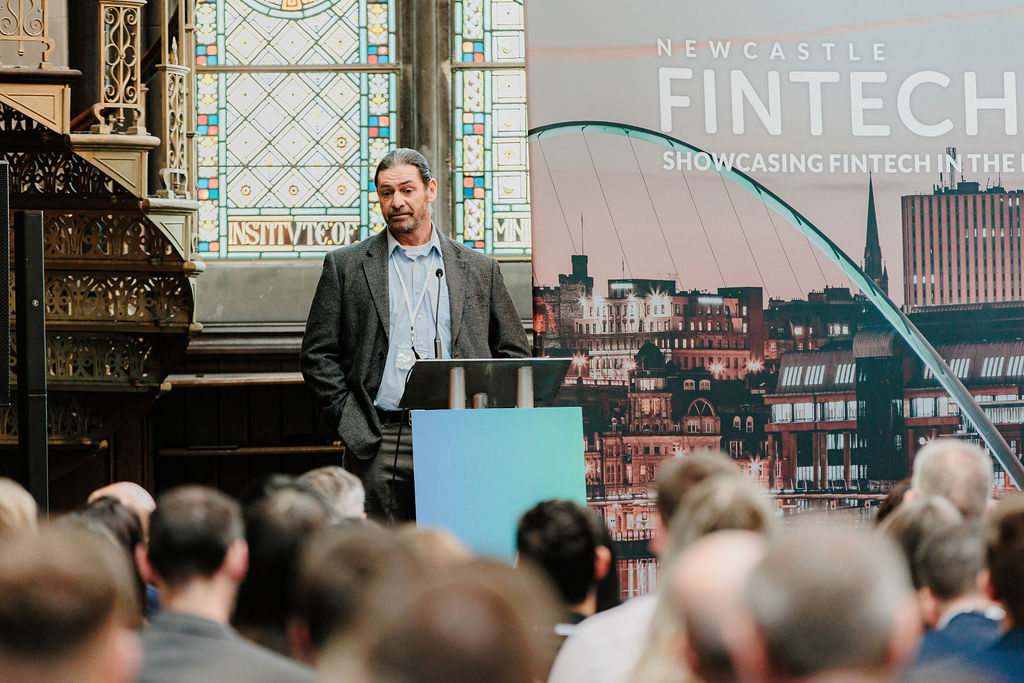
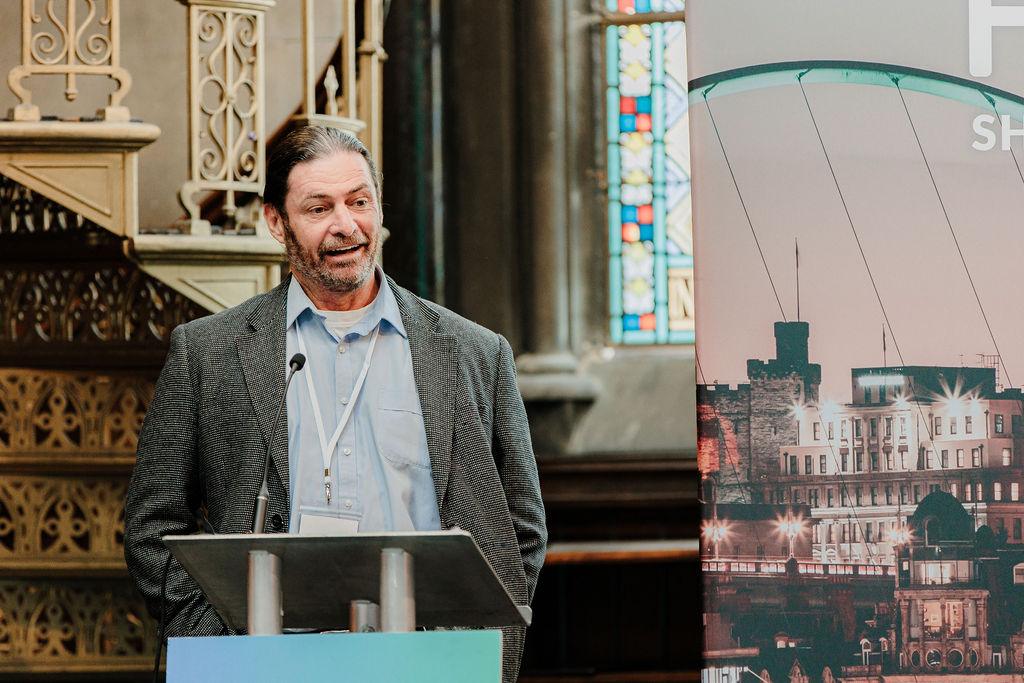
The flagship event made its return to the iconic Wylam Brewery and explored the future of financial services, payments, AI and FinTech as a force for good. Trust, customer experience and collaboration emerged as strong themes throughout the day.
Welcome & regional updates
The day opened with a welcome from Joe Roche, FinTech North’s General Manager. Joe thanked the event’s sponsors and gave an overview of FinTech North’s activity, highlighting the breadth of the ecosystem the organisation supports.

Rachel Burdis, Inward Investment Manager at the North East Mayoral Strategic Authority, followed with a regional welcome. Rachel pointed to the region’s strength in payments and banking, citing the likes of Kani and Atom Bank as examples of the growth already taking place, and positioned the North East as one of the UK’s most exciting FinTech locations. She spoke about the region’s Local Growth Plan, with FinTech, AI and data central to it, referencing the AI consultation published in May and the ambition to build the infrastructure, including investment opportunities around data centre capacity, needed to support AI-enabled growth.
Clare Black, COO of CFIT then delivered the Chris Sier Keynote, opening with a tribute to Chris, FinTech North’s late Chairman, and his habit of asking provocative, sometimes awkward, questions before others realised they mattered. Clare set out a framework for the day: innovation creates potential, trust creates adoption, and it is adoption, not innovation alone, that ultimately creates growth.
She argued that technology is moving faster than governance, a challenge broader than regulation alone, and that the more pressing question is not how intelligent AI will become but how much authority we are prepared to delegate to it. Turning to agentic commerce, Clare described a shift already underway, from AI assisting us to AI acting for us, raising questions of authorisation, liability, audit and reversal that CFIT is actively exploring.
Her challenge to the room was direct: ‘stop asking how quickly we can deploy AI, start asking what people need in order to trust it.’ She closed by framing this as an opportunity for the UK to define the global standard for trust and governance in financial services.
Sector outlook – the future of Financial Services
Next, Stefan Haase, Director at Whitecap Consulting, presented findings from the North of England FinTech Report. Stefan praised the job northern mayors have done representing the region internationally, and noted that FinTech now adds £5bn in GVA to the UK economy each year, forecast to reach £6bn by 2030, progress he described as significant but capable of being much better.
He pointed out that Estonia, a country roughly the size of Leeds, has more internationally recognised FinTech brands than the North of England, and argued the region needs to be louder about its successes, citing Newcastle’s under-shouted-about leadership in cleantech as a case in point. Stefan set out five ideas to accelerate FinTech growth in the North: a northern FinTech accelerator, a northern FinTech investment fund, a North of England FinTech innovation challenge, a centrally coordinated North of England FinTech placements programme, and a pan-northern reskilling programme.
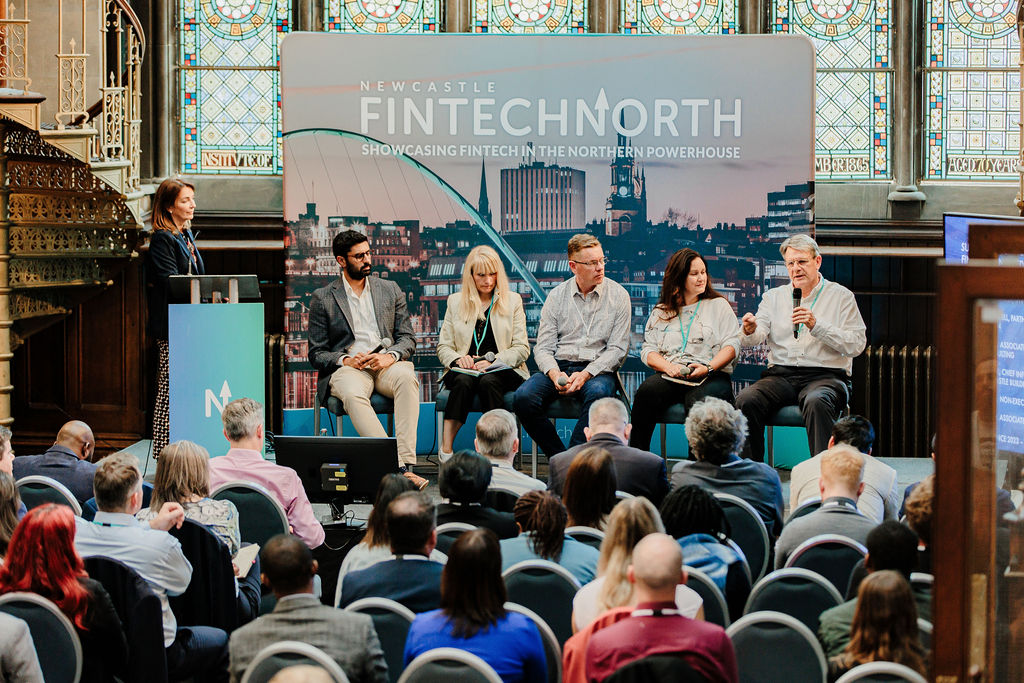
Stefan Haase moved from presenting to moderating the day’s first panel, joined by Dr Emma Black, CEO & Co-Founder of Cascade; Mark Mullen, CEO of Atom Bank; Gordon Stuart, SVP Embedded Services at Sage; David Varney, Partner at Womble Bond Dickinson; and Janet Onyia, Fractional Strategy & Operations Director and COO of Aurelium Kinetic.
Reflecting on a decade of progress, Mark noted that Atom started with six people in 2014 and now employs close to 600, with an average salary of £70k, while Gordon pointed to Sage having re-established its global HQ in Newcastle and hired over 500 graduates in the North East. Janet observed that, ten years on, trust remains the industry’s central conversation, and Emma reflected on Cascade’s own journey since 2012, including the £50m in capital from the Teesside pension fund that backed the business, with Atom’s earlier path proving valuable in showing what was possible.
David pointed to consumer duty, smart data, open banking and open finance as the milestones that have shaped the last decade.

On the importance of success stories, Gordon reflected on the tension between shouting about achievements and the humility that is part of North East culture, concluding the region probably needs to do more of the former. Janet described a ripple effect, where firms serving a central organisation end up relocating their own operations north, while Mark pushed back on any link between excellence and location, pointing to First Direct’s success from a converted shed in south Leeds as proof that London has more people, not necessarily better ones.
On regulation, Mark welcomed the bright spots created by open banking but argued that three decades of talk on digital ID reflects a leadership gap rather than a regulatory one, and questioned whether the PRA truly wants growth companies or simply more payments firms.
Asked from the floor what single change would most help growth, Emma pointed to access to capital as the biggest barrier her business has faced, Gordon cited a recent survey showing UK small businesses use an average of 58 different systems to run their operations, and Mark closed the session on a wider note, arguing the UK is underinvesting in young people relative to the demands of an ageing population, and that business and government need to be as excited about investing in youth as they are in policies for older generations.
Payments innovation
Next to the stage Michael Murray, Commercial & Partnerships Manager at NEPO, spoke about NEPO’s efforts to drive greater collaboration through a ‘one buyer, multiple use’ model. Michael outlined changes brought by the Procurement Act 2023, including greater transparency, more competitive and flexible procedures, pipeline visibility, open frameworks and a stronger SME narrative, while acknowledging that risk aversion, budget pressures and capacity constraints remain real barriers.
He previewed NEPO’s financial innovation and digital payments offering, a national collaboration with ESPO and YPO going out to market in October, and invited attendees to share what their own solutions could offer the public sector.
Following NEPO and continuing the payments them, Katharine Wooller, Chief Strategist Banking & Financial Services at Softcat, moderated a discussion on tokenisation and payments with Dai Davis, Partner, Spencer West LLP; Emma Butterworth, Head of Financial Market Infrastructure Regulation, Bank of England; and Frances Edwards, Chief Operating Officer, Avantgarde.
Frances pointed to significant progress in the native tokenised fund space, including a fund now coming into the UK that is helping to lower the cost of capital, though she stressed the need for larger players to get involved for the ecosystem to scale.
Emma set out three use cases the Bank of England is focused on within wholesale financial markets: collateral management, where tokenisation allows assets to move more easily; synchronised settlement, where payment could happen as soon as delivery occurs rather than after today’s lengthy lags; and the removal of costly, error-prone manual reconciliation.
Asked about legal uncertainty around stablecoin-based payments, Dai was candid: ‘the law is so far behind the tech, it’s a joke.’ and questioned the common assumption that blockchain is inherently secure.
Asked what she would prioritise starting from a blank page, Emma pointed to interoperability, data and money moving seamlessly across borders 24/7, as the single most important enabler, while cautioning that this shouldn’t come ‘at any cost,’ since some frictions in the system are genuinely helpful.
Frances noted that the FCA’s forthcoming crypto asset regime should drive greater consistency across the industry, with future growth needing to be facilitated jointly by regulatory guidance and innovation from larger players.
Looking ahead a decade, Frances predicted individuals will operate in a wallet-based rather than account-based system, with tokenised deposits and reserves helping to bring down the cost of capital across the ecosystem, while Emma suggested the biggest shift will be that people stop thinking about how money moves at all, provided there is trust that different forms of digital money are broadly equivalent to one another.
Lucy Mounter, Director of Business Development & Strategy UK, Intercash, was joined by Kevin McAdam, UK CEO and Executive Director, Andaria, for a conversation on the role strategic partnerships play in bringing payment products to market. Lucy explored what part Andaria plays in bringing cards and payments to life, prompting Kevin to set out Andaria’s position as a principal member of three major card schemes, Discover, Mastercard and Visa, offering clients a full-stack solution spanning issuance, payment rails, tokenisation and, underpinning it all, compliance.
Kevin explained that clients typically arrive with a clear vision but limited understanding of the infrastructure required to deliver it, and that much of Andaria’s value lies in doing that groundwork so businesses can get to market as quickly as possible with a joined-up solution.
He gave the example of a major premiership rugby union club, currently working with Andaria to bring together fragmented technology across multiple layers of their offer from sponsorship, ticketing and season ticket holder management, several point-of-sale providers among them, into a single, smoother end-to-end process, thereby offering a payments and card proposition through an integrated intelligence-led ecosystem.
Data & AI
Hari Govindarajan, Chief AI & Transformation Officer, UK&I, DXC Technology, opened the afternoon session by observing how far AI adoption has spread, from a tool once used mainly by scientists and IT specialists to something every business now wants to apply.
Hari warned of a widening gap in genuine understanding of how AI works, and cautioned that without close attention to the models themselves, organisations risk making that knowledge gap worse rather than better. He set out several reasons organisations fail to scale AI successfully, including data unreadiness, unclear ownership of data within the operating model, and a lack of governance, compounded by a split within workforces between employees eager to use AI and others reluctant to adopt it.
Hari’s message was that closing this gap requires organisations to actively invest in AI skills and to prepare their workforce before, not after, introducing AI into daily operations.
Continuing the AI focus, Kevin Telford, Co-founder, FinPact, moderated a panel exploring trust, data and infrastructure in AI, joined by Nitesh Thadani, CTO, PEXA; Vicky Adeney, Vice President, Data Strategy, UK & Europe, Mastercard; Luke Hope, CTO, Onteric; and Paul Hands, CTO, Ark51. Nitesh stressed the importance of being able to trace exactly where data is going when using AI platforms, warning against using AI blindly and pointing to the value of getting products to market early so that what is and isn’t working can be tracked from the outset.
Luke raised a related concern about inputs coming from markets where AI use isn’t regulated, and argued that while human-in-the-loop review is valuable, the goal should be moving towards genuinely deep human analysis of AI outputs rather than simple approval.
Vicky described Mastercard’s governance framework as designed around traceability and transparency, noting that a human in the loop, while sometimes giving the perception that it slows processes down, ultimately builds the long-term trust that speeds things up again, and highlighted growing appetite among large corporates to collaborate and share capabilities, resources and skills.
Paul argued organisations should treat AI ‘like a junior employee’ whose decisions need checking, just as human work is checked by other humans, and posed a pointed question to the room: what is the contingency plan if AI platforms stop working tomorrow? He suggested resilience comes from ensuring AI is used to build tools and frameworks rather than being relied upon for irreversible decisions.
Across the panel there was broad agreement that data reliability remains the weak point underpinning trust in AI, with progress in areas like open banking offered as a template, and that closing this gap, alongside stronger governance and clearer accountability for AI-driven decisions, will determine how quickly the sector can scale its use of the technology responsibly.
Fintech as a Force for Good
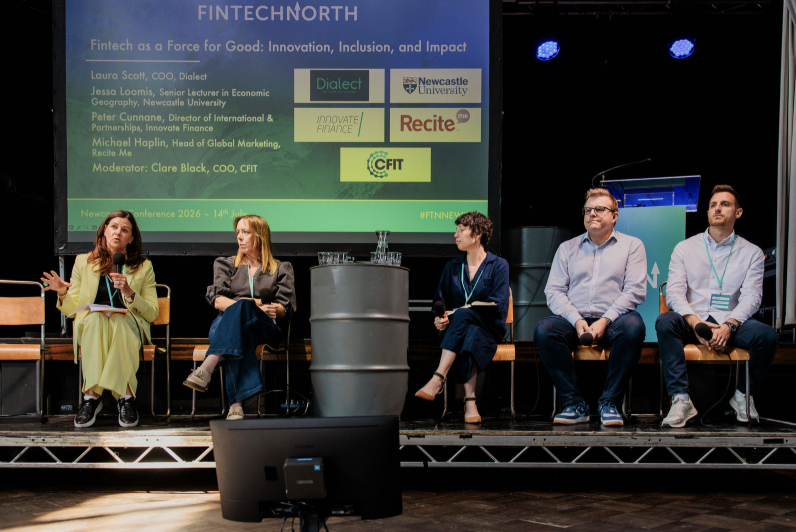
Clare Black, COO of CFIT, then returned to moderate a panel on inclusion, opening with a challenge to the room to look at who is excluded from financial services, where, and why, rather than waiting for regulators to set the agenda. She was joined by Jessa Loomis, Senior Lecturer in Economic Geography at Newcastle University; Laura Scott, COO of Dialect; Peter Cunnane, Director of International & Partnerships at Innovate Finance; and Michael Halpin, Head of Global Marketing at Recite Me.
Jessa argued that designing for a specific target user often means accidentally excluding others, and pushed the panel to think about who has historically been excluded from a given product and why, whether through age, accessibility or past experience. She reflected on perceptions around the use of BNPL technology vs traditional credit, and highlighted the need for greater education for consumers in this space.
Laura spoke about the risk of building products without the customer’s actual journey and circumstances in mind, arguing that technology needs a human element alongside it to build trust, and pointed to Dialect’s multilingual solutions as one way different actors are coming together to tackle inequality.
Peter pointed to FinPact as a North East success story, particularly around skills and connectivity, and suggested other regions could benefit from reflecting that model, given the gap that often exists between academia and industry elsewhere. Separately, he warned that scams and phishing are becoming more sophisticated in ways that disproportionately harm vulnerable people.
Michael focused on the needs of people with disabilities, including dyslexia and communication barriers, arguing the industry needs to think harder about presenting financial information simply and accessibly, and suggesting that in ten years’ time organisations will be built around removing friction from the customer experience by design rather than as an afterthought.
Across the session, the panel returned repeatedly to the idea that inclusion and growth are not competing priorities but can be part of the same strategy.
Deon McCully, Social Value Project Delivery Manager at DXC Technology, moderated a conversation on digital careers with Gavin Ferry, Senior Manager – Learning & Skills at Newcastle United Foundation, and Craig Wilson, STEM Learning Coordinator at Newcastle United Foundation. Gavin spoke about the importance of building resilience and other transferable skills alongside technical ones, and the role of partnerships in giving young people a clear picture of what programmes actually offer, what roles involve, and what prior experience is useful, noting that schools are increasingly alive to their own role in this.
Craig pointed to a significant skills gap in the North in particular, which prompted the Foundation’s decision to work directly with young people to build capability, including students starting their second stage of education, to maximise skills early. Craig and Gavin agreed that genuine, ongoing partnerships with digital platforms and employers, alongside visible role models, are what will help keep talent in the North East rather than losing it elsewhere.
Start-ups Showcase
Oliver Chesher, Managing Director of Galibier, hosted a showcase of regional start-ups, opening with Sateesh Ramoutar, CCO of Easology. Easology, now based in County Durham, builds accessibility software that transforms Samsung smartphones and tablets into simplified, easy-to-use devices for older adults and people with dexterity, sight or cognitive challenges, working with partners including Samsung, Currys and EE.
Sateesh was followed by Lawrence Chadwick-Smith, Head of Marketing at Money Carer, which provides money management, appointeeship and banking services for vulnerable adults across the UK. Money Carer has recently launched the Touch Account — the UK’s first dedicated bank account for people with support needs, built around supported decision-making rather than the binary choice between full independence and substituted decision-making.
At its heart is a unique approach to KYC — Know Your Carer, not just Know Your Customer — which verifies the account holder’s Circle of Care while leaving the supported person in control of who, if anyone, has read-only access to their banking. Alongside it sits Monika, Money Carer’s banking and case management platform, used by local authorities, solicitors and care providers.
Closing the showcase was Siddesh Iyer, CEO and MD at Sportfin, a Newcastle-founded platform that helps sports clubs and community organisations quantify and report the social impact and value they generate, using that data to support real-time fundraising and access to finance. Each founder used their slot to set out the problem their business solves and the traction built so far, giving the room a snapshot of the breadth of FinTech innovation happening across the region.
As the day drew to a close, delegates came together for a final networking session at the evening social at Wylam Brewery’s bar and terrace. Thank you to our brand sponsors Mastercard, DXC Technology, The North East Mayoral Strategic Authority; exhibition sponsors, Crisis City; to all of our fantastic speakers, to the brilliant team at Wylam Brewery, and to our community, for making all of this possible.
For more information and for opportunities for collaboration, please reach out to us at info@fintechnorth.uk.