Northern FinTech Summit 2026, Day 2: Money and Tech & Product
On Thursday 22nd October, the Northern FinTech community gathered at the Guildhall in York for Day 2 of the third annual Northern FinTech Summit, hosted in partnership with Aviva, Barclays Eagle Labs and CubeMatch, with support from the North’s inward investment agencies and exhibition sponsors Layers Studio. The day explored Money and Tech & Product as themes, from funding, investment and tokenisation to agentic AI, trust, user experience and financial inclusion, and closed with the Northern FinTech Showcase.
Missed Day 1? Click here to find out what happened.
Welcome from FinTech North
Joe Roche, General Manager of FinTech North, opened the second day by welcoming delegates, sharing the story of FinTech North so far and highlighting the breadth and diversity of the ecosystem it supports. He thanked the event sponsors, and the team at Barclays Eagle Labs, for hosting and supporting the Summit.
The State of UK Fintech Funding 2026
Joshita Ganesan, Membership Manager & Investment Lead at Innovate Finance, opened the Money session with the headlines from the H1 2026 fintech investment landscape. Global investment slowed to $28bn across 1,411 deals, with AI continuing to attract substantial funding, while the US strengthened its lead with $17.2bn.
The UK, with $1.8bn, saw funding decline by only 5%, retaining second place globally and remaining Europe’s number one fintech hub, and ranked third globally for AI investment behind the US and China. Leading UK deals spanned cross-border payments and FX infrastructure, card issuing, AI compliance and surveillance, credit markets intelligence, and crypto compliance, and Joshita also highlighted a milestone for UK capital markets: the first headline PISCES secondary share sale, a sign of private market liquidity innovation.
Show Me the Money: What It Actually Takes to Get Funded in 2026
Moderated by Angela Yore, Founder & CEO of SkyParlour, who opened by noting that the UK fintech sector could triple in size by 2036, the panel brought together Ant Barker, Director of Venture Capital at Aviva, and Charlotte Scott, Director at Roast my Pitch, to explore how fintechs can get hold of that opportunity. Ant argued that AI and fintech are no longer separate stories: founders need to show how they are using AI to be more efficient and strengthen their proposition, and to have a clear story of integration. He pointed to opportunities such as the advice gap and tokenisation, now scaling at pace, and highlighted the well-recognised scale-up funding gap in the UK, where the pull to launch in the US remains strong. Charlotte said investors are increasingly excited about wealthtech and asset management, aligned with the coming intergenerational wealth transfer, as well as ‘boring’ B2B fintech solutions where founders identify costly problems in banks and show their solution can be adopted safely at scale.
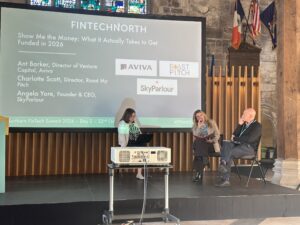
On getting pitch-ready, Charlotte stressed that it takes more than a deck: investors want to see product-market fit, a clear value proposition, healthy unit economics, customer acquisition costs and an understanding of how long it takes to identify and convert customers. She advised founders to build solutions to painful, costly problems, adapting the business model to who pays and who gets value, and to link fundraising to a clear milestone. Ant echoed the importance of solving problems that genuinely need solving, and the panel noted the role the British Business Bank is playing in unlocking pension capital for scale-ups.
Tokenisation, Unpacked: What’s Actually Changing in How Money Moves
Chris Hemsley, Director at S&W, moderated a fireside chat with Frances Edwards, COO at Avantgarde, and Daire Lawlor, Advisor at CubeMatch. Frances described tokenisation as a ‘wrapper’ around a traditional asset, represented on a blockchain: the same asset with a different operational model. She drew a parallel with the ETF wrapper, which changed fund operating models and, through deeper liquidity and large-scale pooling, moved from product to core capital market infrastructure. The real prize, she said, comes when assets and cash sit on the same rails, with tokenised deposits, stablecoins and tokenised money market funds forming the cash leg, enabling use cases such as reduced collateral with near-instant settlement and assets that stay productive rather than sitting idle. Daire highlighted programmability, where smart contracts allow rules such as interest payments to be coded into an asset, and the potential to reduce reconciliations and operational overheads at scale.
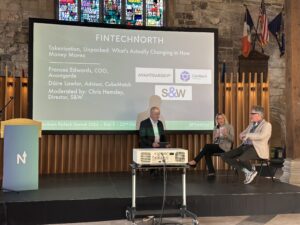
On regulation, Daire stressed that certainty is needed, with a fair bit still to be done even as real funds with real money and real investors are already on chain, while Frances pointed to the importance of being clear in regulations what a stablecoin is and how it can be collateralised. Both emphasised interoperability: rather than siloed pools of money, the goal is an interconnected market where different forms of digital money work together. Looking ahead, they pointed to assets becoming more flexible with efficiency gains happening behind the scenes, with AI as a potential operating layer. While Chris cautioned that risk management and resilience, including third-party resilience frameworks, will matter whether or not a firm is regulated.
The Agentic Shift: AI as Co-Builder, Not Just a Feature
Edward Marshall, CTO at Enablis, opened the Tech & Product session by arguing that engineers are increasingly working not on code itself but on the ‘harness’: everything that runs around a product, from the tools that help maintain it to unit tests and deployment scripts. With the cost of development falling, he said, there is a real opportunity to improve the tooling around the code and to set up agentic AI to build what the business actually needs, while recognising the regulatory concerns about delegating responsibility for code production to an agent.
Edward demonstrated this live by building a 404 page using a skill, and introduced context engineering, equipping agents with the tools and data to make the right decisions. He showed how giving AI the ability to work in small loops, supported by interaction, journey, and service tests, can help maintain high standards.
Building an Agentic FinTech
Anthony Pengleton, AI Practice Lead at Softwire, and Rags Sathanandan, Co-Founder of platform3, shared their journey building together, from a hackday exploring the art of the possible to a flagship financial statements product built in partnership. Using an agentic harness to plan and collaborate, rather than spending time in meetings, has changed not only how they build but how they engage with customers. The results came quickly: investor- and client-ready demos within seven weeks, with neither functionality nor vision stripped back, and features such as pre-populating statements that turn a six to seven week process into a few minutes.
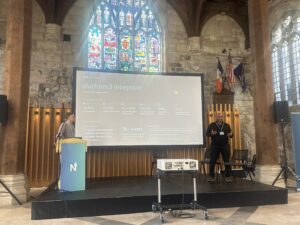
The session’s headline message was that software is no longer the moat or the barrier, because teams can build quickly. Founders can start with a broad vision and work in chunks, scrapping what isn’t necessary, with the vision staying important while the roadmap evolves with the speed and ease of working.
AI Ready? Prove It.
Richard Handley, Director – Data & AI at Red Badger, opened by asking delegates whether they had ever pictured their company’s whole data estate as a tangle, and brought out a round of ‘data excuse bingo’, from ‘our figures don’t match’ to ‘it’s in a spreadsheet somewhere’. AI, he argued, is only the thin layer on top: the real work lies underneath, in data you can find, data everyone defines the same way, data you can prove is right, data only the right people can see, and someone who owns it when it breaks. Citing Gartner, he noted that 60% of AI projects unsupported by AI-ready data are expected to be abandoned through 2026, and that 63% of data management leaders lack, or are unsure of, the data practices AI needs.
He then turned to what regulators will ask of AI, such as which data it used, where that data came from, how you know it was right, whether it has been tested for bias, who could see the data, who signed it off and who can switch it off. His advice was to be honest about where you sit on a four-stage journey from data not yet in the cloud to agentic AI, and, rather than building a bigger data lake, to prove a ‘steel thread’ of real data, end to end, in weeks. As his slides put it, ‘AI is only ever as accurate as the data foundations, end to end.’
The Future of UX: Designing Financial Products People Understand and Trust
James Hanson, MD of Layers Studio, argued that in fintech, trust is built through the experience itself: how a product looks, feels and behaves is how customers judge whether they can rely on it. Accuracy and security are essential, but they only get a firm into the room, making a product trustworthy in principle rather than trusted in practice. He used open banking as an example of a slow burn, technically sound but taking time to scale because trust took time to build, and set out the designer’s job as making the invisible visible.
Looking ahead, James suggested the future of UX is proactive rather than reactive, and warned that technology may arrive faster than trust. Starting with UX and trust, and listening to users, means products are adopted faster, while one bad experience can lose a customer for good.
Tech Innovation Supercharging Financial Inclusion
Helene Panzarino, Chief Ecosystem Director at Money Carer, and Jo Yates, Product Manager at Money Carer, shared the story behind the company’s work managing money for vulnerable clients, built to serve people others find too difficult to cater for. They highlighted innovations including the Touch Account, a biometric card and payment wearables, designed with vulnerable customers in mind but not limited to them, alongside measures against fraud and financial crime.
They also spoke about their ‘from friction to fruition’ workshops, where challenges are worked through together, and the lesson that the biggest reason something fails is that the problem statement and solution aren’t clearly defined. Longevity is creating extra financial pressures, with limited government support leaving many people reliant on families, and Helene reminded the room that ‘financial independence impacts all independence’.
Northern FinTech Showcase
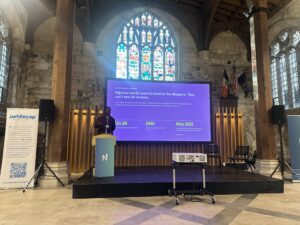
Moderated by Rachel England, Events & Project Manager at FinTech North, the Showcase gave seven founders the chance to pitch:
- Paul Hands, CTO at Ark51: Ark51 is an AI-driven contract management platform for financial services firms. It turns complex legal agreements into searchable, structured data to support risk, compliance and trading decisions.
- Suz Ferreira, Founder of Suz Finance: Suz is a modern wealth-building platform designed for women, helping them invest, save and grow their financial future.
- Freddie Gjertsen, Co-Founder & CEO at Prompted: Prompted uses AI to compare the small print of insurance policies, helping travel and business customers find cover that matches what they actually need, rather than simply the cheapest price.
- Angela Jayne Walton, Co-founder & CEO at alvovi: alvovi is developing a smart, secure SaaS platform that brings life admin together in one place. Its aim is to make everyday life easier, keeping it personal, private and prepared.
- Hawa Kandeh, Founder & MD at AI TechTouch: AI TechTouch is a human-first AI literacy platform for children aged 5–11, designed for schools, libraries and community learning environments. It combines responsible AI literacy with gamified STEM challenges and creative problem-solving, guided by educators and built with safeguarding in mind.
- Simon Catley, Co-founder at Canongate AI: Canongate AI provides daily political violence and political risk intelligence for specialty insurance underwriters, scoring every country against every peril, every day, with the evidence attached.
- Josh Ojo, Founder of Ndewo: Ndewo helps people carry their credit history and financial identity across borders when they move, alongside tools to manage, grow and understand their money in one app.
Closing Remarks
As the Summit drew to a close, delegates left with a fuller picture of how funding, tokenisation, agentic AI and trust-led design are shaping the future of financial services in the North.
Thank you to our hosts and partners, Aviva, Barclays Eagle Labs and CubeMatch; to the North’s inward investment agencies for their support; to our exhibition sponsors, Layers Studio; to all of our speakers and panellists; and to our community for making the Summit possible.
For more information and for opportunities for collaboration, please reach out to us at info@fintechnorth.uk.